
From the limestone East Side to the new west-side subdivisions
Concrete Contractors in Joliet, IL
Driveways, patios, stamped concrete, walks, steps and garage slabs, permitted and poured to the City of Joliet rules.
- Free on-site measuring visit
- Written quote broken out line by line
- Joliet driveway and sidewalk permits pulled by us, as the city requires
Concrete Work Across Every Part of Joliet
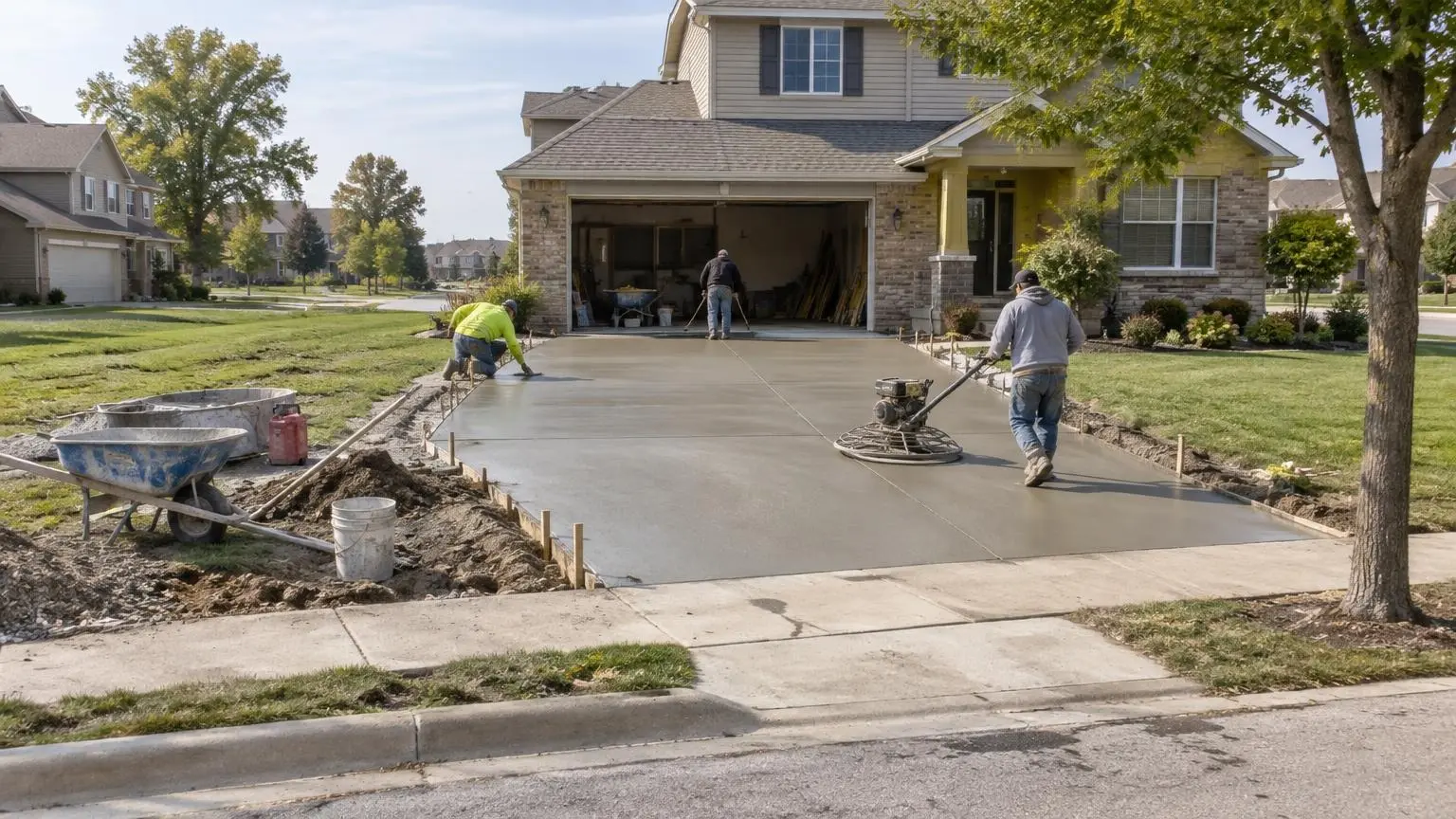
If you are comparing concrete contractors in Joliet, the first thing worth knowing is how different one side of the city is from the other. The East Side and the Upper Bluff hold homes from the 1850s through the 1920s, while the far west side, out toward Plainfield and Minooka, is mostly subdivisions built in the last 25 years. Joliet grew from 76,836 residents in 1990 to 147,459 in 2010 and counted 150,362 in 2020. That gives us everything from cracked century-old front steps to builder-grade driveways that are starting to scale.
What the city requires on a driveway
The City of Joliet permit packet sets clear minimums, and we build to them on every job. A driveway slab must be at least 4 inches thick with wire mesh, and concrete in the approach or where the drive crosses the public sidewalk must be 6 inches thick with mesh. Residential driveways are capped at 20 feet wide at the front property line. In the public right-of-way the apron can be up to 20 feet at the public walk and 26 feet at the curb, and any change needs Public Works approval. Gravel is not an allowed driveway surface, and the city requires a contractor to pull the permit, so we handle the application, the plat of survey markup and the scheduling.
Older homes on the East Side and the Bluff
The Joliet East Side Historic District, listed on the National Register in 1980, has 290 buildings in styles from Greek Revival and Italianate to Prairie School. The Upper Bluff Historic District, listed in 1991, adds 616 buildings, most from the late 1880s into the early 1900s. On these blocks the work is usually front walks, stoops, porch steps and narrow side drives. Old walks are often heaved by tree roots, and steps have often been patched more than once. We match the scale of the house: plain broom finishes, careful joint spacing and step heights that meet the porch the way the original did.
Limestone ground and a river valley
Joliet was built on limestone. Stone quarried here went into the Old State Capitol and the Chicago Water Tower, and downtown sits low in the Des Plaines River valley. In practice that means some lots have shallow rock, some have heavy clay fill, and the low ground near the river holds water. We dig out soft spots, compact a stone base and slope every slab so water runs off toward the yard or street instead of sitting against the foundation.
Joliet winters are hard on concrete
The city has recorded lows of minus 26 degrees and highs of 109, and averages about 38 inches of precipitation a year. All that freezing and thawing, plus road salt tracked up the driveway, is what makes surfaces flake and edges crumble. We use air-entrained mixes, cut control joints at the right spacing, give the slab time to cure and recommend a penetrating sealer before the first winter.
Work we do in Joliet
- Driveways: tear-out and replacement, widening toward the side lot line and new 6-inch aprons
- Patios: broom-finish slabs, larger backyard patios and extensions off an existing slab
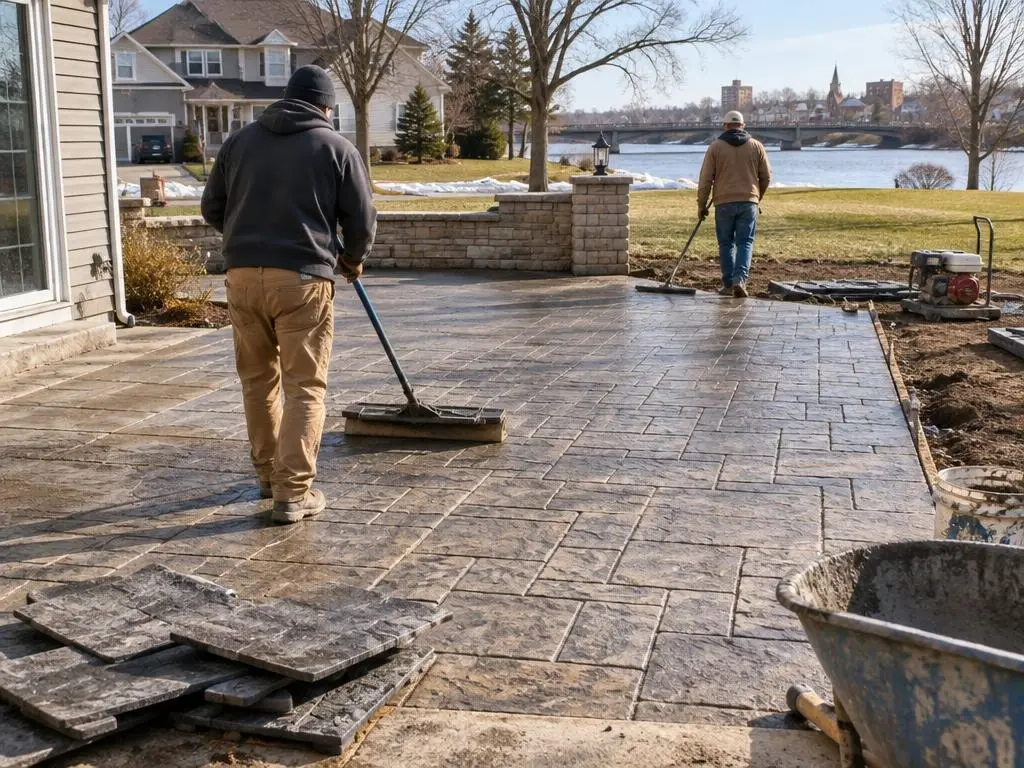
- Stamped and colored concrete: patterns for patios and walks where the HOA allows it
- Sidewalks and steps: front walks, side paths, stoops and replacement steps
- Garage and shed slabs: detached garage floors, shed pads and equipment pads
- Repairs: sunken panels, trip edges, crumbling steps and scaled surfaces
Call (815) 205-0805 or send a few details about the project and we will set up a time to measure.
Joliet Facts That Affect a Pour
- Driveway thickness. City permit packet: driveway slabs at least 4 inches with wire mesh; approaches and concrete at sidewalks 6 inches with mesh.
- Width limits. Residential driveways max 20 feet at the front property line; aprons max 20 feet at the public walk and 26 feet at the curb.
- Who pulls the permit. The city packet says a contractor must pull the driveway permit, and the job must stay out of all easements.
- Historic districts. The East Side district (1980) has 290 buildings and the Upper Bluff district (1991) has 616.
- Growth. Population rose from 76,836 in 1990 to 150,362 in 2020, with 52,737 housing units counted in 2020.
Joliet Questions
Do I need a permit to replace my driveway in Joliet?
Yes. The city requires a Driveway and Sidewalk Permit with a plat of survey showing the work, a construction plan and a contract copy, and a contractor has to pull it. We prepare and submit the paperwork as part of the job.
How thick does a Joliet driveway have to be?
The city minimum is 4 inches with wire mesh for the slab and 6 inches with mesh for the approach and where the drive crosses the sidewalk. Many homeowners choose a thicker slab for trucks or a heavy vehicle, and we can quote both.
Can I put in a gravel driveway in Joliet?
No. The city packet lists concrete, asphalt and brick pavers as driveway surfaces and says gravel is not allowed.
Can you work on an older home in the East Side or Upper Bluff?
Yes. We do walks, steps and stoops on older homes and keep the finish and layout in line with the house. If you are unsure whether a historic review applies, check with the city before the work is scheduled.
Free Estimates in Joliet, IL
Tell us about your Joliet driveway, patio, walk or steps and we will schedule a free estimate.
Concrete Contractors Near Joliet
- Concrete Contractors in Plainfield, IL
- Concrete Contractors in Bolingbrook, IL
- Concrete Contractors in Romeoville, IL
- Concrete Contractors in Lockport, IL
- Concrete Contractors in New Lenox, IL
- Concrete Contractors in Shorewood, IL
- Concrete Contractors in Crest Hill, IL
- Concrete Contractors in Mokena, IL
- Concrete Contractors in Frankfort, IL
- Concrete Contractors in Homer Glen, IL
- Concrete Contractors in Channahon, IL
- Concrete Contractors in Minooka, IL
- Concrete Contractors in Orland Park, IL
- Concrete Contractors in Tinley Park, IL
- Concrete Contractors in Manhattan, IL
- Concrete Contractors in Lemont, IL
- Concrete Contractors in Oswego, IL
- Concrete Contractors in Naperville, IL
- Concrete Contractors in Elwood, IL
- Concrete Contractors in Wilmington, IL
- Concrete Contractors in Morris, IL
- Concrete Contractors in Woodridge, IL
- Concrete Contractors in Rockdale, IL